The Label Is the Source of Truth
Most bakery software prints the label last. We print it first — and every number in the system, from stock to true cost per product, flows from that one action on the floor.
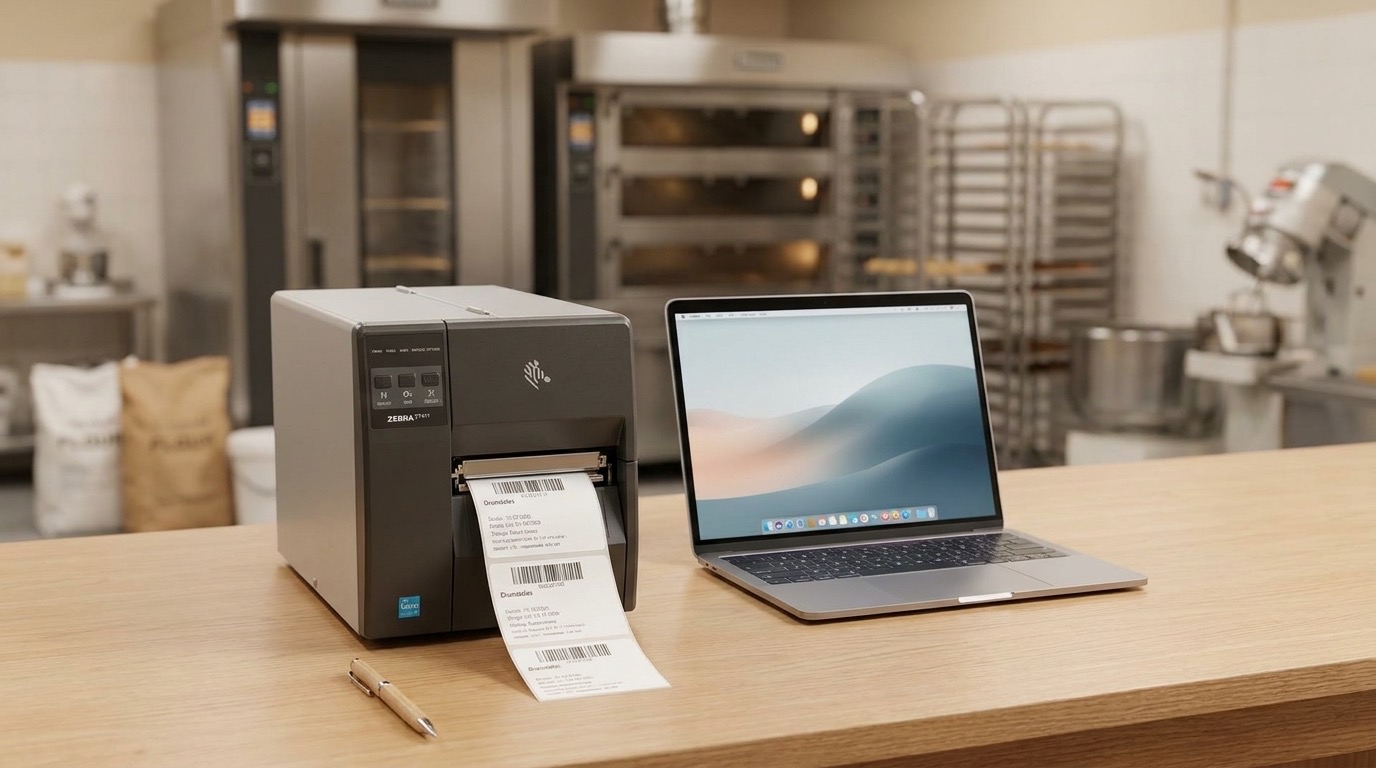
Most bakery software treats the label as the last step — something you print once everything else is already recorded. We build everything the other way around. In BakeryMS, the label is the first step, and every other number in the system flows from it.
That one design decision is why a bakery running BakeryMS doesn’t need a dedicated office person typing in production data all day. Let me explain how it works, because it’s simpler than it sounds — and it’s the part I’d copy first if I were setting up a small or medium factory.
What you need: a label printer and a screen
The hardware is deliberately boring. You need a ZPL label printer — any brand works; we use Zebra — and a laptop.
Why a laptop and not a tablet or a phone? The screen. An employee mid-production needs to navigate fast, and a bigger screen means fewer taps and less time lost. We go one step further and plug in an external monitor at the production station. It sounds trivial, but shaving a few seconds off every label, dozens of times a day, is exactly the kind of small friction that decides whether a system actually gets used or quietly abandoned.
The label is born from a recipe
Here’s the chain. Every recipe is connected to an item, and the item defines what kind of label we print. That connection is what turns a printed sticker into data.
Take a cottage cheese cake. We want to know the exact weight produced — but employees don’t always have time to weigh every single item, and stopping to do so would slow the whole line. So we handle it two ways:
- Known average weight. If we know a cake averages 2 kg, we set that. Print 10 stickers, and the system records 10 × 2 kg = 20 kg produced. No weighing required.
- Variable batches. If the batch weight can genuinely vary, we configure the item to ask the employee how much they made, and they enter the real number.
Either way, the moment that sticker prints, the system logs everything attached to it: time, date, who produced it, quantity, batch number, and best-before date. One action on the floor, and a complete production record exists — without anyone in an office touching a keyboard.
Every step gets recorded, from repacked cheese to finished croissant
This isn’t only for finished products. We record every small step in the chain.
It starts as early as repacking — grating a block of cheese on the grinder and repacking it into 1 kg boxes gets a label. It ends with the finished item, a cottage cheese cake or a croissant. Everything in between is captured the same way, by the same simple action: produce, print, done.
For a small-to-medium factory, I think this is close to the perfect flow. You have to record what’s produced somehow — there’s no avoiding it. So instead of hiring office staff to do data entry, you let the people already on the floor generate the record as a natural by-product of their work.
The label they were going to print anyway is the data. That’s the whole trick.
Batches and frozen stock recalculate themselves
Because every label is tied back to its item, the system understands relationships between products — and this is where it starts to feel less like record-keeping and more like intelligence.
Say you make a batch of dough today and print its sticker. Tomorrow you bake cookies that draw from that same dough. The stock recalculates automatically — the dough you used is deducted, the cookies you made are added, and you never had to reconcile anything by hand. Frozen and batch products flow through the same logic. The sticker follows the product through every transformation.
Traceability the inspector loves
There’s a compliance payoff to all this that we didn’t fully anticipate. Because every product carries a label that traces back to its batch, its production time, and its producer, everything is traceable end to end. Our sanitary inspection genuinely likes this flow — when they can follow any finished product back to the exact batch and moment it was made, an inspection stops being a scramble through paperwork.
Built to prevent mistakes
A source of truth is only as good as its accuracy, so the system is built with guardrails. It prevents double prints. It signals unusually large quantities in the production report so an obvious mistake gets caught immediately. Duplicates get flagged. The point isn’t to distrust the team — it’s to make the right action easy and the wrong action hard, so the data you’re building everything on stays clean.
Where it gets powerful: labels plus clock-in
At Bazaar Bakery we run the label printer alongside NFC clock-in, and together they unlock something most small bakeries never get to see: true cost per product.
The labels tell us exactly what was produced and when. The clock-in tells us who was working and for how long. Put them together and we can calculate real monthly cost — and, more importantly, spot which products carry a bad margin because they take too long to make. A product can look profitable on ingredients alone and quietly lose money on labour. When the label is your source of truth and it’s linked to actual working hours, that hidden loss finally becomes visible.
That’s the real reason the label sits at the centre of everything. It’s not just a sticker with a date on it. It’s the single, trustworthy record that every other insight — stock, traceability, and ultimately true margin — is built on top of.
Want to see how the label flow works in your own factory? Get in touch — I’ll walk you through it.
Want to see it in action?
I’ll walk you through it myself — and set your shop up as a founding customer.
Get in touchBazaar Bakery runs seven shops and a central factory in Riga. BakeryMS is the software that runs them — built on the floor, then opened up for other bakeries.
More from the shop floor
Bakery labels in the EU: what they must show, and how to get them right at the moment of production
Prepacked, packed at the counter or sold loose: three situations, three sets of rules. Here’s what each label needs, where bakeries usually slip, and how to make the recipe the single source of the label.
Why I built BakeryMS
I didn’t set out to build software. I set out to run a bakery.